Serving Aurora, Denver Metro & Colorado | 15+ Years of DUI Defense

Many people assume police officers ask questions during a DUI investigation simply to “figure out what is going on.” In reality, officer questioning is often one of the most important parts of a Colorado DUI or DWAI case.
Statements made during roadside questioning frequently become evidence used later in:
- DUI prosecutions,
- DMV express consent hearings,
- suppression motions,
- plea negotiations,
- and jury trials.
At The Lawrence Law Firm, we carefully evaluate not only chemical testing evidence, but also the statements allegedly made during a DUI investigation. In many cases, those statements become a major part of the prosecution’s theory of impairment.
For more information about evidence-based DUI defenses, visit our Colorado DUI Defenses page.
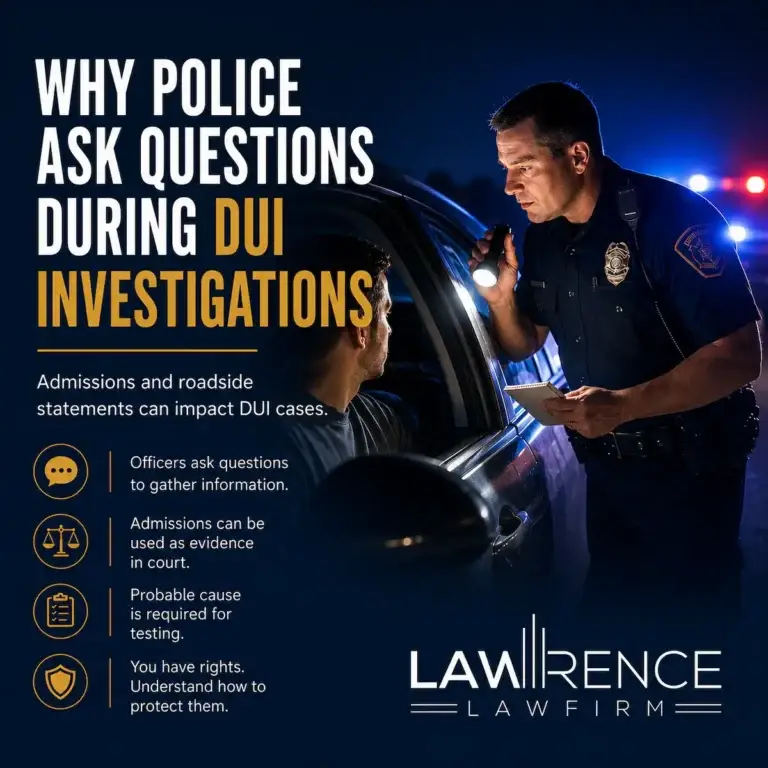
Why Officers Ask DUI Questions
During a DUI investigation, officers commonly ask questions such as:
- “Where are you coming from?”
- “Where are you going?”
- “Have you been drinking tonight?”
- “How much have you had to drink?”
- “When was your last drink?”
- “Do you feel safe to drive?”
- “On a scale from 1–10, how impaired do you think you are?”
Although these questions may seem conversational, they are often designed to gather evidence supporting:
- reasonable suspicion,
- probable cause,
- chemical testing requests,
- and ultimately criminal prosecution.
Admissions can become powerful evidence in court. Even seemingly minor statements may later be argued by prosecutors as evidence that a driver acknowledged impairment.
Learn More:
Probable Cause for a DUI in Colorado
One of the most important legal concepts in a Colorado DUI investigation is probable cause.
Probable cause is a legal standard requiring police officers to have enough facts and circumstances to form a reasonable belief that a person:
- drove,
- was driving,
or - exercised actual physical control of a motor vehicle
while under the influence of alcohol or drugs.
Probable cause is more than a mere hunch or suspicion, but it does not require proof beyond a reasonable doubt. Instead, officers must rely upon the totality of the circumstances surrounding the investigation.
In DUI cases, officers commonly rely on factors such as:
- odor of alcohol,
- admissions to drinking,
- bloodshot or watery eyes,
- slurred speech,
- poor driving behavior,
- balance issues,
- field sobriety test performance,
- witness statements,
- or bodycam observations.
No single factor automatically establishes probable cause in every case. Instead, courts generally evaluate all of the circumstances together.
This issue becomes especially important in cases involving:
- parked vehicles,
- sleeping drivers,
- welfare checks,
- REDDI reports,
- or actual physical control allegations.
Unlike a traditional DUI stop, officers in these situations often do not observe:
- swerving,
- speeding,
- accidents,
- lane violations,
- or other evidence of bad driving.
Because of this, officers frequently rely much more heavily on questioning and admissions to establish probable cause.
How Probable Cause Relates to Colorado Express Consent
Probable cause also directly impacts Colorado’s Express Consent Law, CRS 42-4-1301.1.
Under Colorado law, a police officer generally cannot require a driver to submit to a chemical breath or blood test unless the officer first develops probable cause to believe the person was driving or exercising actual physical control while impaired.
In other words, the probable cause analysis and the express consent analysis are closely connected. The same observations officers rely upon to justify a DUI arrest are often the same facts used to invoke express consent procedures and request chemical testing.
For example, officers may rely upon:
- admissions to drinking,
- odor of alcohol,
- roadside questioning,
- field sobriety tests,
- witness statements,
- or observations of impairment
to justify both:
- the DUI arrest itself,
and - the decision to require chemical testing under express consent laws.
This is one reason roadside questioning can become so important in Colorado DUI cases. Statements made early during an investigation may later be used by prosecutors to argue:
- the officer had probable cause,
- the arrest was lawful,
- and the chemical test request was legally justified.
Constitutional issues involving implied consent and chemical testing have also been addressed by the United States Supreme Court in cases such as Birchfield v. North Dakota, 579 U.S. 438 (2016).
Why Questioning Matters in Actual Physical Control Cases
Colorado actual physical control cases are often highly fact-specific because officers frequently encounter individuals after the vehicle is already parked rather than actively driving. In these situations, prosecutors may attempt to prove impairment through circumstantial evidence such as the location of the vehicle, whether the engine was running, where the keys were located, statements made by the driver, and whether the person appeared capable of operating the vehicle. Colorado courts have recognized that actual physical control determinations require a case-by-case analysis based on the totality of the circumstances. See People v. Swain, 959 P.2d 426 (Colo. 1998). Because police officers often rely heavily on questioning to establish timelines and recent driving activity in APC investigations, roadside admissions can become some of the most important evidence in the case.
Actual physical control cases are often more complicated than ordinary DUI stops.
In many APC investigations, the officer arrives after the vehicle is already parked. The officer may find someone:
- sleeping in the vehicle,
- sitting in a parked car,
- parked outside a residence,
- or stopped on the side of the road.
Without observing actual driving, officers often attempt to establish timeline evidence through questioning.
For example, officers may ask:
- whether the person drove recently,
- when they arrived,
- whether they drank before or after driving,
- whether they intended to drive again,
- or where they had been earlier that evening.
Statements made during these encounters can significantly affect the case.
For more information, see our Actual Physical Control DUI page.
The “Scale of 1–10” Impairment Question
One question that has become increasingly common in DUI investigations is:
“On a scale from 1–10, how impaired do you think you are?”
This question can create serious problems for defendants — particularly in refusal cases.
Many people interpret the question casually and attempt to minimize their condition by answering:
- “maybe a 2,”
- “probably a 3,”
- or “not very impaired.”
However, Colorado’s DWAI statute does not require substantial impairment.
Under Colorado law, DWAI or driving while ability is impaired means:
impaired to the slightest degree.
That distinction can become critically important at trial.
A juror may hear someone admit they were a “2” or “3” and conclude:
“Even the defendant admitted impairment.”
The jury typically does not receive detailed guidance about what a person subjectively means by a “2” or “3.” Instead, prosecutors may argue the statement itself demonstrates impairment consistent with DWAI.
This issue often becomes even more important in refusal cases where there is no chemical test result.
Without a BAC result, the prosecution may rely more heavily on:
- officer observations,
- admissions,
- bodycam footage,
- and roadside statements.
Smell of Alcohol Alone Is Usually Not Enough
One issue that frequently arises in Colorado DUI investigations is the smell of alcohol.
Many people are surprised to learn that the odor of alcohol alone does not automatically establish impairment.
The smell of alcohol may indicate:
- recent consumption,
but it does not necessarily establish: - intoxication,
- inability to drive safely,
- or impairment beyond the legal threshold.
However, officers are trained to investigate further when they detect the odor of alcohol.
In practice, officers often combine:
- odor of alcohol,
- admissions to drinking,
- late-night driving,
- bloodshot eyes,
- nervousness,
- or minor driving behavior
to justify expanding the investigation.
In many cases, admissions become the missing piece officers rely upon to justify further DUI investigation procedures.
Admissions Can Create Problems Even After Driving Ends
These questions can also create issues in cases where police do not actually observe driving.
For example, officers may receive:
- a REDDI report,
- a citizen complaint,
- or vehicle information tied to a registered address.
Police may then contact the registered owner at home.
If the individual admits:
- they were driving earlier,
- consumed alcohol before driving,
- and did not drink after arriving home,
those statements may become the basis for a later DUI or DWAI charge — even though officers never observed the vehicle in motion.
These situations often become highly fact-specific and may involve substantial legal defenses regarding:
- timing,
- operation,
- actual physical control,
- and proof of impairment while driving.
Admissions Can Sometimes Help Mitigation and Sentencing
Although admissions during a DUI investigation can create evidentiary problems, context still matters.
Not every DUI defense strategy involves “winning” the case outright. In many situations, the focus becomes:
- reducing charges,
- limiting penalties,
- avoiding jail,
- protecting a license,
- or presenting mitigation to prosecutors and judges.
In some cases, honesty and cooperation may later help demonstrate:
- remorse,
- accountability,
- acceptance of responsibility,
- or reduced public safety concerns.
For example, prosecutors often view refusal cases as aggravating because refusals can suggest:
- non-cooperation,
- concealment,
- or unwillingness to comply with law enforcement.
However, the facts surrounding a refusal can matter significantly.
A person who states:
“I already told you I’ve been drinking — why do I need the test?”
may present differently from someone who is openly combative or attempting to obstruct the investigation.
Similarly, admissions acknowledging poor judgment may sometimes become useful mitigation evidence during:
- plea negotiations,
- sentencing arguments,
- probation discussions,
- alcohol evaluations,
- or negotiations involving alternative sentencing options.
That does not mean admissions are automatically beneficial. In many cases, statements still create substantial evidentiary problems. However, effective DUI defense often involves evaluating both:
- how statements affect the prosecution’s evidence,
and - whether those same facts may later support mitigation or sentencing strategy.
At The Lawrence Law Firm, we evaluate DUI cases from both perspectives. Some cases involve strong suppression or evidentiary defenses, while others focus more heavily on minimizing long-term consequences and positioning the client for the best possible outcome.
Police Training and DUI Investigations
This is not to say officers are necessarily “looking to arrest innocent people” or acting improperly simply because they ask questions.
Law enforcement officers receive extensive DUI investigation training. When officers detect alcohol, their training and experience often lead them to investigate possible impairment.
From the officer’s perspective, questioning is frequently viewed as part of determining:
- whether someone may be impaired,
- whether they recently drove,
- and whether they are safe to continue operating a vehicle.
However, from a defense perspective, these statements can later become some of the most important evidence in the case.
DUI Defense Often Involves More Than Chemical Tests
Many Colorado DUI cases involve far more than a breath or blood test. Officer observations, roadside questioning, body camera footage, admissions, and probable cause determinations often become central issues in both DUI and DWAI prosecutions. In actual physical control and refusal cases, these details can become even more important because prosecutors may rely heavily on circumstantial evidence and statements made during the investigation.
At The Lawrence Law Firm, we carefully evaluate every stage of a DUI investigation, including whether the stop was lawful, whether officers properly established probable cause, whether express consent procedures were legally invoked, and whether roadside admissions or officer observations can be challenged. Our approach focuses not only on potential suppression and evidentiary issues, but also on mitigation strategies designed to reduce long-term consequences when appropriate.
To learn more about Colorado DUI laws, defenses, penalties, and investigation procedures, visit our Colorado DUI Defense page. If you are facing DUI, DWAI, refusal, or actual physical control allegations in Colorado, contact The Lawrence Law Firm to discuss your case and possible defense options.
.