Serving Aurora, Denver Metro & Colorado | 15+ Years of DUI Defense

Many drivers assume that a Colorado DUI case is only about what happens in court. Unfortunately, that is not true. In many situations, a DUI arrest can create separate consequences with the Colorado Department of Revenue that affect your ability to drive long after the criminal case ends. One of the most overlooked consequences is Persistent Drunk Driver (PDD) status — a designation that can require years of ignition interlock, additional alcohol treatment, and significant delays in fully restoring your license.
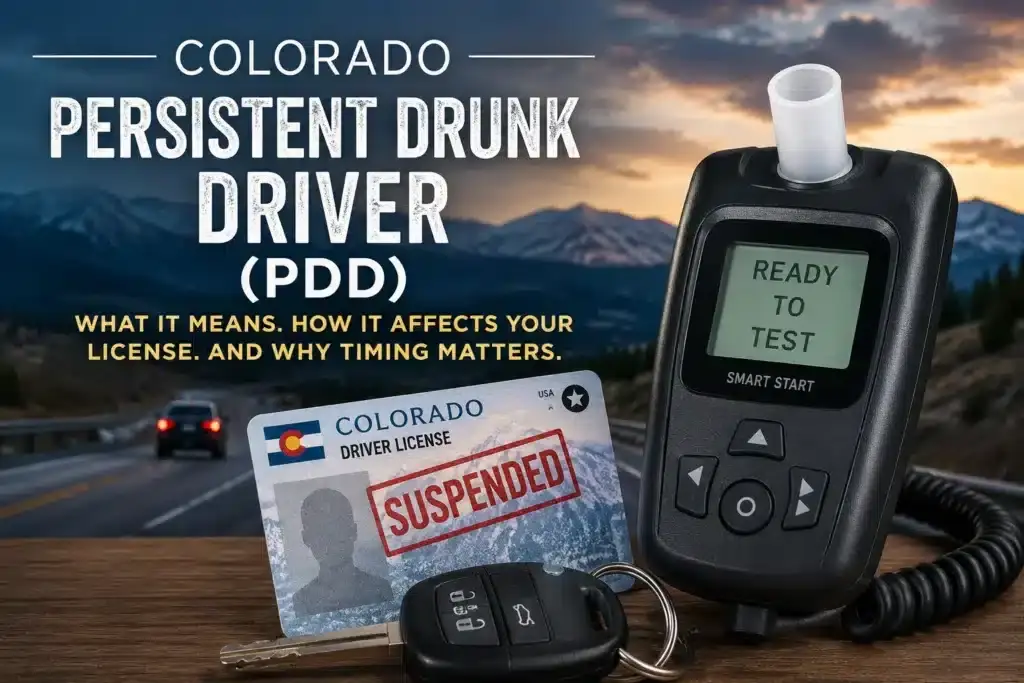
What Does Persistent Drunk Driver Status Mean in Colorado DUI Cases?
Many people arrested for DUI in Colorado focus on the criminal case. They worry about court dates, possible jail time, probation, fines, and whether a conviction can be avoided.
What many drivers do not realize is that Colorado has another set of consequences that exist outside of the criminal court process. One of the most important is something known as Persistent Drunk Driver status, often referred to as PDD.
Despite the name, a person does not necessarily need multiple DUI convictions to be labeled a Persistent Drunk Driver. In fact, some first-time offenders can face PDD consequences immediately.
Understanding how PDD status works is important because it can significantly affect your driver’s license, ignition interlock requirements, and how long it takes to fully regain driving privileges.
What Is Persistent Drunk Driver Status in Colorado?
Persistent Drunk Driver status is a designation created under Colorado law that triggers additional administrative consequences through the Colorado Department of Revenue.
Unlike the criminal DUI case, which takes place in court, PDD status primarily affects your driving privileges and the steps required to restore your license.
A driver can be classified as a Persistent Drunk Driver in several situations, including:
- Having a blood alcohol content (BAC) of 0.15 or higher
- Refusing a chemical test after a DUI arrest
- Having multiple alcohol-related driving offenses
- Driving on a revoked license after a prior alcohol-related suspension
This means even someone facing a first DUI offense may be classified as a Persistent Drunk Driver.
PDD Status Is Separate From Your Criminal DUI Case
One of the most confusing parts of Colorado DUI law is that there are often two separate processes happening at the same time.
First, there is the criminal case in county or municipal court. This determines whether a person is convicted of DUI, DWAI, or another offense.
Second, there is the Department of Motor Vehicles process, which controls license suspension and reinstatement.
The DMV can impose consequences even before the criminal case is resolved.
This distinction matters because some drivers assume that resolving the court case solves everything. Unfortunately, that is often not true.
Even if the criminal case ends favorably, PDD-related license restrictions may still apply.
How PDD Status Affects Your Driver’s License
The biggest consequence of Persistent Drunk Driver status usually involves the ignition interlock requirement.
In many DUI cases, a driver may be eligible to restore driving privileges early by installing an ignition interlock device.
However, once PDD status applies, Colorado generally requires two years of ignition interlock compliance.
That means:
- The driver must install an approved ignition interlock device
- The device must remain installed for a full compliance period
- Violations can restart the timeline
- Driving without compliance can create additional suspensions
For many people, this becomes one of the most frustrating and expensive parts of the DUI process.
Why Waiting to Install Interlock Can Be a Mistake
One issue I regularly discuss with clients is timing.
Some drivers assume it makes sense to simply wait through the entire license revocation period before taking any action.
In many PDD cases, that strategy creates problems.
The reason is simple.
Even if you wait months — or longer — to begin the reinstatement process, the two-year ignition interlock requirement usually does not begin until you actually install the device and start the compliance period.
In other words, waiting often does not eliminate the interlock requirement.
Instead, it can delay the point at which you begin working through the two-year compliance period.
For drivers who know they will eventually need to drive again, it is often worth evaluating whether installing interlock sooner makes more sense.
Every case is different, but this is an issue many people overlook.
Refusing a Chemical Test Can Trigger PDD Status
Many drivers believe refusing a breath or blood test helps avoid consequences.
That is not always true.
Colorado operates under an express consent law, meaning drivers who lawfully operate a motor vehicle are deemed to have consented to chemical testing when an officer has probable cause for DUI.
Refusing a chemical test can trigger:
- Automatic license revocation
- Use of refusal evidence in court
- Persistent Drunk Driver designation
- Additional requirements for license reinstatement
In some situations, refusal can complicate both the criminal case and the DMV consequences.
PDD Status Often Involves Alcohol Education and Treatment
Persistent Drunk Driver designation frequently leads to additional treatment requirements.
Depending on the case, a driver may be required to complete:
- Alcohol education classes
- Therapy or treatment programs
- Level II education
- Level II therapy requirements
These requirements can become expensive and time-consuming.
Many people focus on court fines while underestimating the long-term financial consequences that come from the DMV side of the case.
Common Misunderstandings About Persistent Drunk Driver Status
Several misconceptions come up regularly.
“I only have one DUI, so PDD does not apply.”
Not true. A BAC of 0.15 or higher can trigger PDD status on a first offense.
“If I wait out my suspension, I can avoid interlock.”
Often incorrect. The compliance period usually begins once interlock is installed.
“If my criminal case gets reduced, PDD disappears.”
Not necessarily. DMV consequences operate separately from the criminal case.
“Refusing the test avoids serious consequences.”
Refusal often creates additional problems rather than fewer.
Why Early Advice Matters After a Colorado DUI Arrest
A DUI arrest in Colorado often creates more consequences than people initially realize.
The criminal case is only one piece of the process.
License suspension issues, ignition interlock requirements, treatment obligations, and Persistent Drunk Driver consequences can affect someone long after the court case ends.
Because these issues often begin immediately, understanding the full picture early in the process can make a significant difference.
If you have been arrested for DUI in Colorado, it is important to understand both the criminal charges and the DMV consequences that may follow.
An experienced Colorado DUI attorney can help you evaluate your options and avoid mistakes that may make the process more difficult in the long run.