Colorado DUI Cases Are Not Automatic Convictions
A DUI arrest is not the same thing as a conviction. Prosecutors must still prove:
- You were driving or in actual physical control of a vehicle;
- You were substantially incapable of safely operating the vehicle due to alcohol, drugs, or both; or
- Your blood alcohol content exceeded Colorado’s legal limit.
In many cases, prosecutors rely heavily on:
- Officer observations;
- Statements made during the stop;
- Field sobriety tests;
- Breath test results;
- Blood test results; and
- Driving behavior.
However, every part of the investigation can potentially be challenged.
Some cases involve weak evidence from the beginning. Others involve legal issues that may lead to suppression of evidence. Even when dismissal is not possible, identifying weaknesses in the prosecution’s case can significantly improve negotiations, sentencing outcomes, or trial strategy.
Challenging the Traffic Stop
One of the first questions in many DUI cases is whether police legally stopped the vehicle in the first place.
Under Colorado law, officers generally need reasonable suspicion to initiate a traffic stop. This means the officer must be able to point to specific facts suggesting a traffic violation or criminal activity occurred.
Examples commonly cited by officers include:
- Swerving;
- Speeding;
- Lane violations;
- Equipment violations;
- Driving without headlights; or
- Reports from other drivers.
However, not every stop is legally justified. Sometimes officers exaggerate driving behavior or rely on vague observations that may not satisfy constitutional standards.
If the stop was unlawful, evidence gathered afterward may potentially be suppressed. This can include:
- Statements;
- Field sobriety tests;
- Breath tests;
- Blood tests; and
- Other evidence obtained after the detention.
To learn more about constitutional challenges to DUI investigations, visit our illegal traffic stop DUI defense page.
Field Sobriety Tests Are Highly Subjective
Many DUI arrests are heavily based on roadside field sobriety tests (SFSTs). Officers often present these tests as scientific indicators of impairment, but they are far from perfect.
The most common standardized field sobriety tests include:
- Horizontal Gaze Nystagmus (HGN);
- Walk-and-Turn; and
- One-Leg Stand.
These tests are designed to divide a person’s attention between mental and physical tasks. However, many sober people can struggle with them for reasons unrelated to alcohol or drug impairment.
Factors that can affect SFST performance include:
- Nervousness;
- Fatigue;
- Medical conditions;
- Injuries;
- Age;
- Uneven pavement;
- Poor lighting;
- Improper footwear;
- Weather conditions; and
- Officer instructions.
In some cases, officers also fail to properly administer or score the tests according to training standards.
Importantly, field sobriety tests are often subjective. Two officers may interpret the same performance differently. Body-worn camera footage sometimes contradicts what appears in the police report.
You can learn more about these issues on our Colorado field sobriety test defense page.
Breath Test Results Can Be Challenged
Breathalyzer evidence is often viewed as powerful evidence in Colorado DUI prosecutions. However, breath tests are not infallible.
Colorado commonly uses the Intoxilyzer 9000 breath testing machine. While prosecutors frequently rely on these results, multiple issues can affect reliability.
Potential breath test defenses may involve:
- Improper calibration;
- Operator error;
- Mouth alcohol contamination;
- Medical conditions such as GERD or acid reflux;
- Failure to follow observation periods;
- Residual alcohol in the mouth;
- Radio frequency interference; or
- Problems with machine maintenance records.
Breath testing also estimates blood alcohol concentration indirectly. It does not directly measure alcohol in the bloodstream.
In close cases, even relatively small inaccuracies may become important. This is especially true in DWAI cases or cases near the legal limit.
For more information, visit our breath test defense resource.
Blood Test Evidence Is Not Always Conclusive
Blood tests are often considered more reliable than breath testing, but blood evidence can still be challenged.
Blood DUI cases frequently involve:
- Chain of custody issues;
- Improper storage;
- Fermentation;
- Contamination;
- Delayed testing;
- Improper handling procedures; or
- Lab analyst errors.
In addition, prosecutors must still prove that the blood sample accurately reflected impairment at the time of driving.
Timing issues can become particularly important in DUI cases. Alcohol absorption does not occur instantly, and blood alcohol levels can continue rising after a person stops driving.
This is sometimes referred to as the rising BAC defense.
If testing occurred significantly later, prosecutors may face challenges proving what the BAC actually was while the person operated the vehicle.
You can learn more on our blood test DUI defense page.
You Can Be Charged Without Actually Driving
Many people are surprised to learn that Colorado DUI law does not always require a person to be actively driving.
Under Colorado law, prosecutors may pursue DUI charges if they believe someone was in “actual physical control” of a vehicle while impaired.
Actual physical control cases often involve situations where:
- A person was sleeping in a parked car;
- The engine was running;
- The keys were accessible;
- The vehicle was parked on the roadside; or
- Officers believed the person could readily operate the vehicle.
These cases can become highly fact-specific.
For example:
- Was the vehicle legally parked?
- Was the engine running?
- Was the person attempting to drive?
- Was the individual using the vehicle for shelter or warmth?
- Where were the keys located?
In some situations, prosecutors may struggle to prove the defendant actually intended or was capable of operating the vehicle.
You can learn more about these cases on our actual physical control DUI defense page.
Medical Conditions Can Mimic Impairment
Not every sign officers associate with intoxication is actually caused by alcohol or drugs.
Certain medical conditions can mimic common DUI indicators, including:
- Slurred speech;
- Bloodshot eyes;
- Balance problems;
- Confusion;
- Fatigue;
- Difficulty following instructions; or
- Poor coordination.
Examples may include:
- Diabetes;
- Neurological disorders;
- Inner ear conditions;
- Anxiety;
- Fatigue;
- Head injuries; or
- Prescription medication side effects.
Even simple exhaustion or stress can affect a person’s appearance and roadside performance.
Because officers often make rapid decisions during traffic stops, they may incorrectly interpret medical symptoms as intoxication.
Learn more about these issues on our medical conditions and DUI defense page.
Every DUI Case Requires Individualized Analysis
There is no single defense strategy that applies to every DUI case.
Some cases involve:
- Constitutional suppression issues;
- Weak officer observations;
- Technical chemical testing problems;
- Negotiation opportunities;
- Sentencing mitigation;
- Evidentiary inconsistencies; or
- Trial defenses.
Other cases may focus on minimizing long-term consequences rather than pursuing dismissal.
A strong DUI defense often requires reviewing:
- Police reports;
- Body-worn camera footage;
- Dispatch records;
- Calibration and maintenance records;
- Laboratory procedures;
- Officer training records; and
- Witness statements.
In some situations, expert witnesses such as toxicologists or accident reconstructionists may also become important.
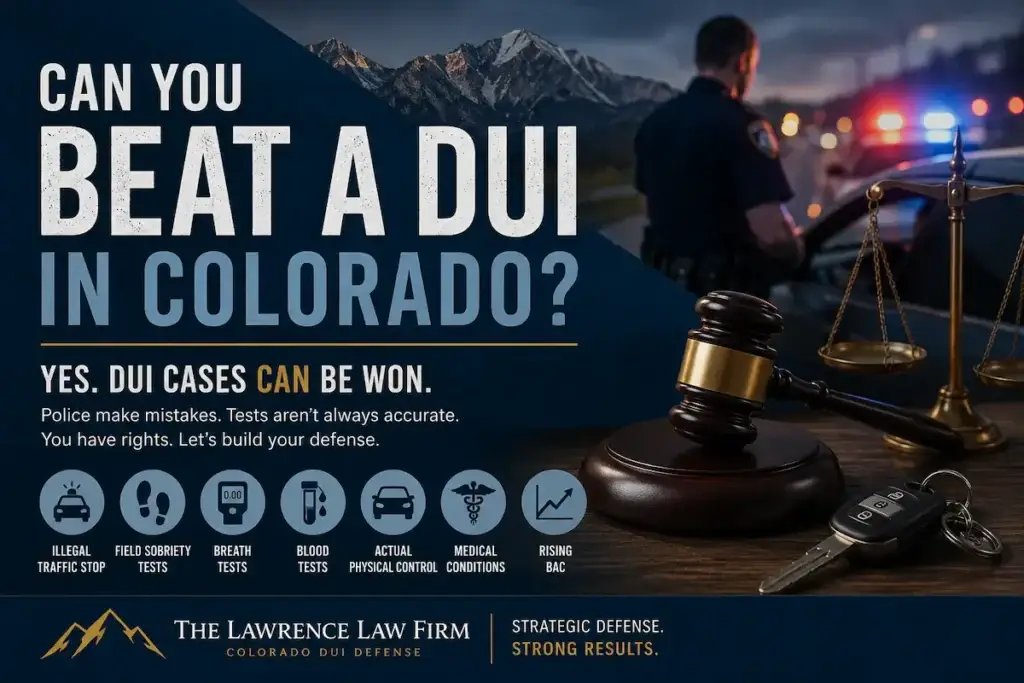
Can You Beat a DUI in Colorado?
Many people ask whether fighting a DUI is worth it. The answer depends on the evidence, the potential consequences, and the long-term impact a conviction could have on your life.
A DUI conviction in Colorado can affect:
- Driver’s license status;
- Employment opportunities;
- Professional licensing;
- Insurance rates;
- Criminal history;
- Immigration consequences; and
- Future sentencing exposure.
Even if dismissal is not ultimately possible, identifying weaknesses in the prosecution’s case can often improve plea negotiations or sentencing outcomes.
The important thing is to avoid assuming the case is hopeless simply because an arrest occurred.
Frequently Asked Questions
Is it difficult to beat a DUI in Colorado?
DUI cases can be challenging because prosecutors often rely on multiple forms of evidence, including officer observations, field sobriety tests, breath testing, blood testing, and body-worn camera footage. However, DUI arrests are not automatic convictions, and many cases contain weaknesses worth challenging.
Can breath or blood test results be challenged?
Yes. Breath and blood testing evidence can potentially be challenged for issues involving calibration, contamination, improper procedures, chain of custody problems, rising BAC arguments, or medical conditions that may affect results.
What if I was not actually driving the vehicle?
Colorado DUI law allows prosecutors to pursue charges under an “actual physical control” theory even if a person was not actively driving. These cases are highly fact-specific and may depend on issues such as where the keys were located, whether the engine was running, and where the vehicle was parked.
Should I fight a DUI charge?
That depends on the facts of the case, the strength of the evidence, and the potential consequences of a conviction. A DUI conviction can affect your driver’s license, employment opportunities, insurance rates, and criminal history. Even when dismissal is not possible, identifying weaknesses in the prosecution’s case can often improve negotiations or sentencing outcomes.
Speak With a Colorado DUI Defense Attorney
If you were arrested for DUI, DWAI, or DUID in Colorado, it is important to understand that every case has potential defenses worth evaluating. The earlier an attorney becomes involved, the more opportunities there may be to preserve evidence, investigate constitutional issues, and develop a defense strategy.
At The Lawrence Law Firm, our DUI defense lawyer defends clients facing DUI charges throughout the Denver Metro Area, including Aurora, Arapahoe County, Adams County, Douglas County, Jefferson County, and Denver.
To learn more about potential defense strategies, visit our Colorado DUI defenses resource hub or contact our office to discuss your case.