Serving Aurora, Denver Metro & Colorado | 15+ Years of Personal Injury and Criminal Defense Experience

When people hear the phrase jury selection, they often imagine lawyers searching for the perfect juror to help their side win the case.
The reality is very different.
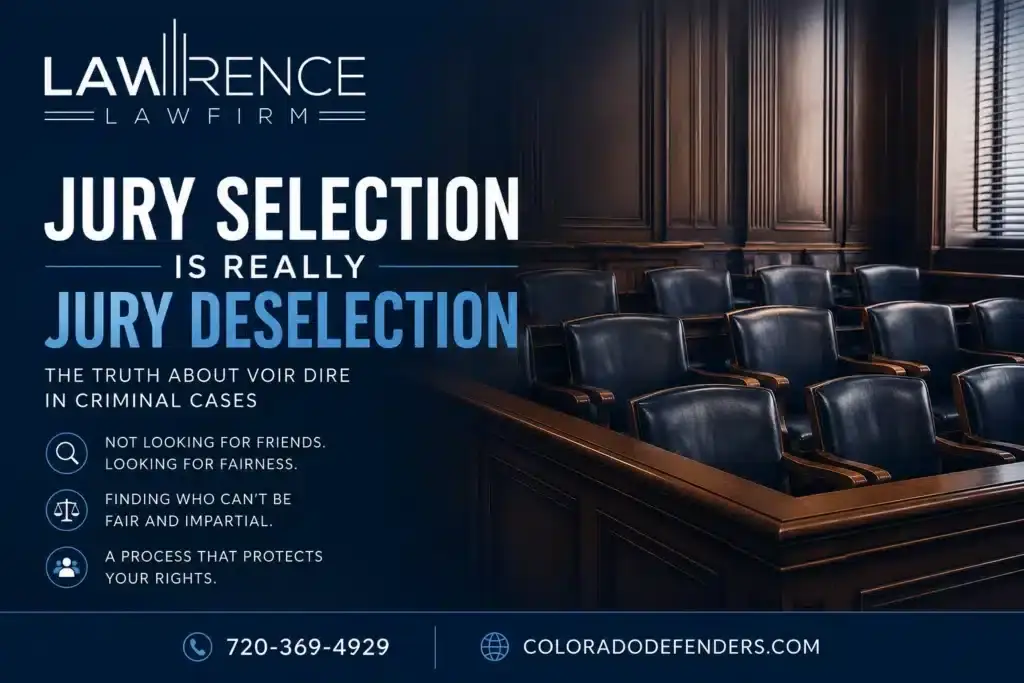
In most Colorado criminal defense cases, jury selection is really jury deselection. The goal is not to find jurors who will favor one side or the other. Instead, the goal is to identify people who may not be a good fit for that particular case and remove them from consideration.
The recent attention surrounding high-profile trials, including the Anthony case in Texas, has generated renewed public interest in how juries are chosen. Many people are surprised to learn that jury selection is often less about choosing who serves and more about determining who should not.
Not Every Person Is a Good Fit for Every Trial
One of the first things our attorney often tell potential jurors is that not every person is a good fit for every case.
That does not mean there is something wrong with the juror.
It simply recognizes that life experiences matter.
For example, an attorney whose practice focused on car accident cases would probably not be an appropriate juror in a car accident lawsuit. His professional background would inevitably influence how he viewed evidence, insurance companies, damages, and legal issues.
That does not make him biased in everyday life. It simply means he may not be the right person to decide that particular case.
The same principle applies across all types of trials. The purpose of jury selection is to determine whether prospective jurors can fairly evaluate the evidence presented in the courtroom rather than relying on personal experiences, preconceived opinions, or outside information.
How Jury Selection Works in Colorado
Although the overall process is similar throughout Colorado, every county and every judge tends to handle jury selection somewhat differently.
In criminal cases:
- Misdemeanor trials are decided by six jurors.
- Felony trials are decided by twelve jurors.
Municipal ordinance violations operate differently. A jury trial is not automatic and must generally be requested. Municipal courts may permit fewer than six jurors, although I routinely request six whenever a jury trial is available.
The specific procedures may vary from courtroom to courtroom, but the overall goal remains the same: determining whether prospective jurors can be fair and impartial.
The Judge Usually Starts the Process
Jury selection generally begins with questions from the judge.
Some judges focus heavily on legal principles. Common topics include:
- The presumption of innocence.
- The burden of proof.
- The concept of proof beyond a reasonable doubt.
- The requirement that the prosecution prove every element of the charge.
Other judges focus more on general background information, such as:
- Name.
- Occupation.
- Age or date of birth.
- Marital status.
- Spouse’s occupation.
- Prior jury service.
Many courts also use written questionnaires that ask additional questions before jurors even enter the courtroom. These questionnaires may ask about:
- Prior experiences with law enforcement.
- Whether the juror has been a victim of crime.
- Whether a family member has been charged with a crime.
- Any reason the juror believes they may have difficulty being fair and impartial.
The purpose is not to embarrass anyone or invade anyone’s privacy. The purpose is to identify issues that could affect the juror’s ability to fairly evaluate the evidence.
Some Questions Are Required by Law
Colorado courts also ask statutory qualification questions designed to determine whether a person is legally eligible to serve.
These questions may include whether the person:
- Lives in the county where the trial is being held.
- Has served on a jury within the previous twelve months.
- Can read, speak, and understand English.
- Otherwise meets the legal qualifications for jury service.
These questions are generally straightforward and help ensure that the jury is legally constituted before the trial begins.
Fairness and Impartiality Are the Central Issues
Throughout the entire voir dire process, the judge and attorneys are evaluating one fundamental question:
Can this person be fair and impartial?
That question often becomes most important when the case involves emotionally charged allegations.
In my experience, certain types of cases almost always generate strong reactions from prospective jurors, including:
Without fail, there is often someone in the jury pool who has personally experienced one of these situations or has a close family member who has.
Others may have particularly strong opinions about the subject matter regardless of personal experience.
There is nothing wrong with that. These are serious issues that naturally produce strong feelings.
The question becomes whether those feelings would prevent the juror from fairly evaluating the evidence presented in court.
What Is a Challenge for Cause?
If a prospective juror demonstrates that they cannot be fair and impartial, that person may be removed through what is called a challenge for cause.
A challenge for cause essentially means the court determines that the juror should not serve because something about their circumstances would interfere with their ability to fairly decide the case.
Examples may include:
- A juror who already believes the defendant is guilty.
- A juror who cannot follow the law as instructed by the judge.
- A juror who cannot fairly evaluate testimony from law enforcement.
- A juror whose personal experiences are too closely connected to the allegations being tried.
Sometimes the issue is not bias at all.
Our attorney has had prospective jurors removed because they could not adequately hear the proceedings or could not fully understand English.
That does not mean those individuals are unfair or incapable people.
Rather, we want every juror to personally hear and understand the evidence. we do not want a juror forced to rely on another juror’s interpretation of what occurred during trial.
The goal is for every juror to independently evaluate the evidence and reach their own conclusions.
Attorneys Then Get Their Turn to Question Jurors
After the judge finishes, the attorneys are usually given an opportunity to question the jury panel.
The amount of time varies considerably by courtroom.
In many Colorado courts, attorneys may receive approximately 15 to 20 minutes per side, although judges can grant additional time depending on the complexity of the case.
This portion of the process often reveals the most useful information because it allows attorneys to explore issues that may become important during the trial.
Different Lawyers Have Different Approaches
Every lawyer approaches jury selection differently.
Many prosecutors understandably follow a relatively structured script designed to cover common topics and legal principles.
Our approach tends to focus more on themes and issues that I believe will matter later during the trial, particularly during closing argument.
For example, one question we frequently ask is:
“How often do you use the phrase ‘beyond a reasonable doubt’ in your everyday life?”
The answer is usually the same.
Almost never.
People understand the phrase. They have heard it before. But it is not a standard we use in our daily decision-making.
That discussion becomes important later because one of my concerns is that jurors may naturally revert to the standards they use in ordinary life when evaluating evidence.
In closing argument, we may return to that concept and remind jurors that the criminal justice system intentionally asks them to apply a higher standard than they normally use.
The idea is not to lecture jurors or talk down to them.
Instead, it is a way to emphasize that beyond a reasonable doubt is intentionally different from everyday decision-making and deserves careful attention.
We Are Not Looking for Friends
One of the biggest misconceptions about jury selection is that lawyers are trying to find jurors who will agree with them.
That is not the goal.
A defense attorney is not looking for friends.
A prosecutor is not looking for friends.
The objective is to identify people who can fairly evaluate the evidence and follow the law.
The best juror is not someone who already agrees with either side.
The best juror is someone who is willing to keep an open mind until all the evidence has been presented.
What Are Peremptory Challenges?
After questioning is complete, both sides are allowed to exercise peremptory challenges.
Unlike challenges for cause, a peremptory challenge does not require the attorney to prove that the juror is biased.
Instead, the attorney may remove the juror without providing a detailed explanation.
However, there are important constitutional limits.
Under Batson v. Kentucky and related cases, attorneys cannot use peremptory challenges based on race, sex, or other protected characteristics.
If a Batson challenge is raised, the attorney must provide a race-neutral and legally permissible explanation for the strike.
While peremptory challenges remain an important part of jury selection, they are not unlimited.
Why Lawyers Focus on the Jury Box
Another aspect of jury selection that often surprises people is that attorneys are usually not questioning every prospective juror.
A typical jury pool may contain 50 to 80 people.
Yet only a smaller group will initially be seated in or near the jury box.
For practical reasons, attorneys generally focus their attention on those individuals because they are the people most likely to actually serve.
For example, if there are twelve seats in the jury box, it makes little sense to spend significant time questioning someone who is fiftieth in line.
Given the limited time available, attorneys must focus on the prospective jurors who realistically have a chance of becoming members of the final jury.
As challenges are exercised and people are excused, additional jurors move forward and become part of the group being evaluated.
Frequently Asked Questions About Jury Selection in Colorado
What is voir dire?
Voir dire is the process of questioning prospective jurors before a trial. The goal is to determine whether jurors can be fair, impartial, and willing to follow the law as instructed by the judge.
How many jurors serve in a Colorado criminal case?
Most misdemeanor trials in Colorado are decided by six jurors, while felony trials are decided by twelve jurors. In criminal cases, the verdict must generally be unanimous.
What is a challenge for cause?
A challenge for cause is a request to remove a prospective juror because something about the juror’s circumstances would prevent them from fairly deciding the case. Examples may include a juror who has already formed an opinion about the case or cannot follow the law.
What is a peremptory challenge?
A peremptory challenge allows an attorney to remove a prospective juror without proving bias. However, attorneys cannot use peremptory challenges based on race, sex, or other protected characteristics.
Why do some attorneys call jury selection “jury deselection”?
Many trial attorneys view the process as jury deselection because the focus is often on identifying prospective jurors who may not be a good fit for a particular case. Rather than searching for the “perfect” juror, the process is designed to remove individuals who may have difficulty fairly evaluating the evidence and applying the law.
The Jury Is What’s Left
At the end of the process, after challenges for cause and peremptory challenges have been exercised, the jurors who remain become the jury that decides the case.
In many respects, that outcome highlights why the phrase jury selection can be misleading.
The process is not really about finding the perfect juror.
It is about removing prospective jurors who may not be able to fairly decide the case.
What remains is a group of citizens who have sworn to listen to the evidence, follow the judge’s instructions, and decide the case based solely on what happens inside the courtroom.
That is why experienced trial lawyers often view voir dire not as jury selection, but as jury deselection—a process focused on identifying who should not serve so that those who remain can fairly perform one of the most important duties in our justice system.